

Single Origin vs Blend Coffee: What the Words Mean, and Why Our One-Origin Coffee Is Called a Blend
Single origin coffee comes from one place: a single country, region, farm or lot. A blend mixes coffees from several origins. Neither is better by definition. Single origins show off a place and change with each harvest, while blends are built to taste close to the same all year. Ours is single origin, every bean Colombian, and the "blend" in its name is a blend of roast levels.
We are a family roaster in a barn in Cedarburg, Wisconsin, and we make one coffee. We call it our German Norwegian Blend, and it is also single origin, so here are both words explained plainly, with the honest trade-offs.
What single origin means
Single origin is a broad label. The coffee company Trade gives a simple working definition: coffee that comes from one place and is not mixed with other coffees. Bean Box describes the term as a ladder rather than a single rung. From the widest rung to the narrowest:
- Country. "100% Colombian." Every bean grew in one country, usually on many farms.
- Region. One growing area inside that country.
- Cooperative or mill. Coffee from many small neighboring farms, gathered and processed together.
- Farm or estate. One producer's coffee.
- Micro-lot. One small plot on one farm, processed and sold on its own.
The narrower the rung, the more the coffee tastes of one place and one season, and the smaller the supply. The label tells you where a coffee came from, not how good it is, how it was roasted or how fresh it is.

Why roasters blend
A blend is two or more coffees combined on purpose. Roasters blend for a few honest reasons:
- Consistency. Coffee is a crop, and different countries harvest at different times of year. A blend lets a roaster swap in another coffee when one crop runs out or comes in different, so the bag tastes close to the same in March and in October.
- Balance. One coffee can bring body and another brightness. Trade's example pairs a heavy, low-acid Brazilian coffee with a brighter Colombian one, so the pair tastes rounder than either alone.
- Espresso and milk. Bean Box calls blends the forgiving default for espresso: they hold their character in milk and tolerate small changes in the shot.
- A steady price. Our own FAQ says grocery store coffee "is usually blended from multiple origins and grades," and low-cost blends often include Robusta, a cheaper, more bitter species than Arabica. Mixing helps a big brand hold both taste and price steady.
None of these is a bad reason. A good blend takes real skill: the roaster has to taste every component and keep the whole steady as crops change.
Is one better?
No. A carefully roasted blend beats a stale single origin, and a fresh single origin beats a blend of cheap grades. The trade-offs look like this:
| At a glance | Single origin | Blend |
|---|---|---|
| What it is | Coffee from one place: a country, region, farm or lot | Two or more coffees combined on purpose |
| Over the year | Changes with each harvest; favorite lots sell out | Built to taste close to the same all year |
| What it shows you | The character of one place and one season | The roaster's idea of a balanced cup |
| Typical flavors (Bean Box catalog) | About 3 in 5 bright, fruity, floral or citrusy | About 6 in 7 chocolate, caramel or nutty |
| Espresso and milk | Can be excellent, less forgiving | The common, forgiving choice |
| Price | A little higher: about $2, or 11%, more per 12 oz bag in Bean Box's catalog | A little lower, from cheap cans to careful roaster blends |
| Suits you if | You like to explore, drink it black or brew pour-over | You want the same cup every morning, or take milk |
Pick by how you drink coffee, not by the label. If you love tasting a different farm every month, a rotating single-origin subscription from a specialty roaster will suit you better than we will. If you want one good, steady cup every morning, a well-made blend or a single origin roasted the same way every time fits better.
Our German Norwegian Blend: one origin, many roast levels
Our coffee is 100% Colombian Supremo Arabica. Supremo is Colombia's grade for the largest beans by screen size, and larger beans roast evenly, which matters in cast iron. Our FAQ puts it in six words: "Every bean we roast is Colombian." That makes it single origin at the country level, the widest rung. We buy it through a licensed importer and do not sell it as a single-farm or micro-lot coffee.
Why the word blend, then? In the FAQ's words, "It refers to the roasting approach rather than the origin of the beans." Our family came from Germany and Norway, and as our About page puts it, "Germans opt for a darker roast while Norwegians prefer a lighter variety." Our one roast holds both. We began in a cast iron pan, then built custom cast iron stovetop roasters, and now use a cast iron drum roaster. The beans do not all move at the same pace: "By the time the first beans reach the second crack ... others are still a few shades lighter." Every batch holds a spread of roast levels, and together they finish as a balanced medium-dark roast.
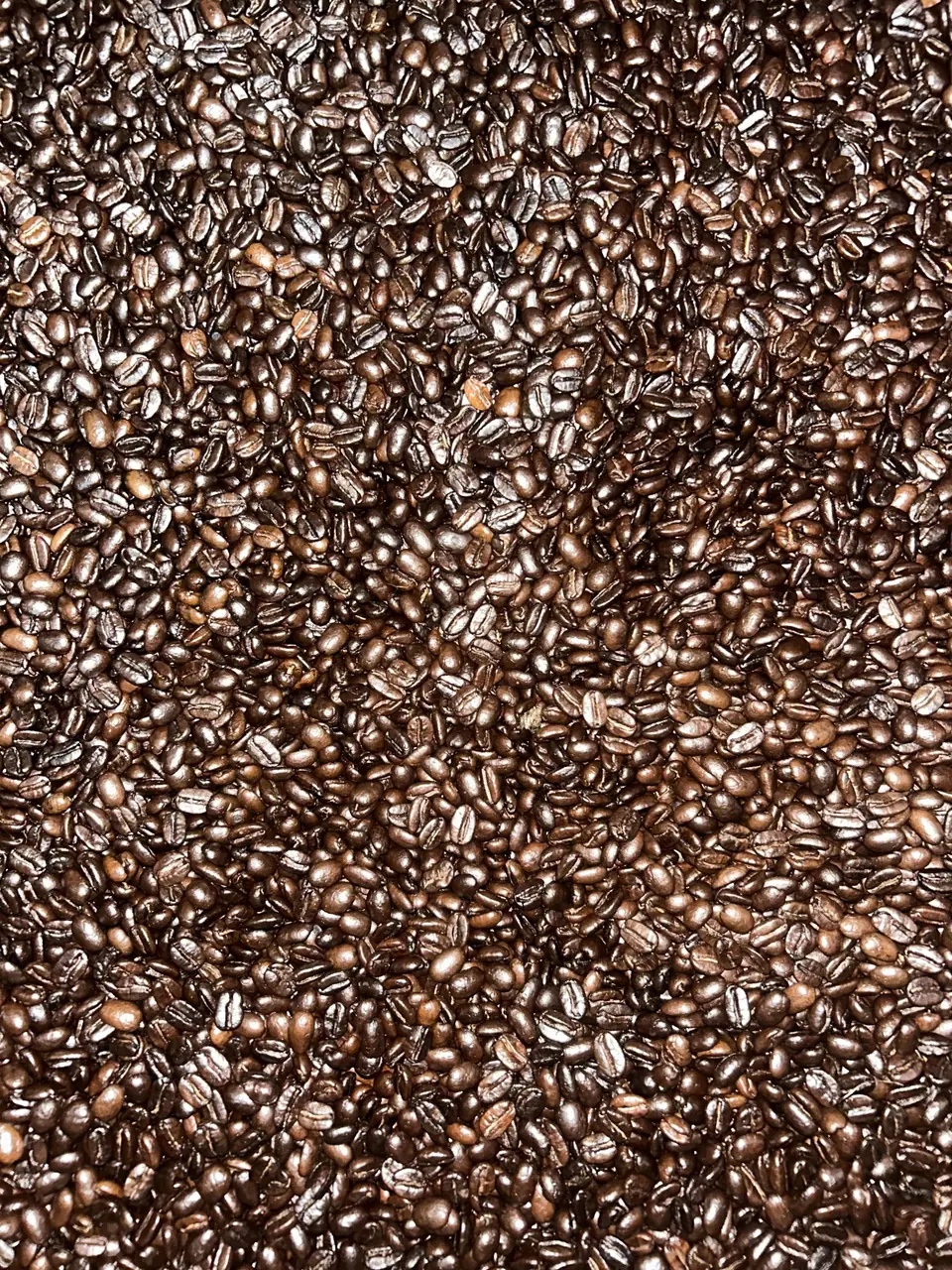
So a bag of ours is single origin and a blend at once: one origin, blended roast levels. Customers describe it as smooth, bold and low in acid, and good black. One customer described the two roast levels this way:
“The blend of dark and medium roast produced a delicious combination of smoky and sweet.”
Mark E, Google, June 2025
Others put it more simply, including one household with German and Norwegian roots:
“We are enjoying our first order! We (both 50% German and he is 50% Norwegian) both LOVE IT!”
Cheryl M, Facebook, December 2025
“It's a perfect blend.”
Christian O, X, September 2026
We roast in small batches on a regular schedule, and it ships within days of roasting in nearly all cases. The longer story of the name is in our signature German Norwegian blend, and the German half of it in what makes German coffee German. For the bean itself, see Colombian Supremo coffee.
Reading origin on a bag
A few lines on any bag tell you most of what you need to know:
- Origin. A country, region or farm name means single origin. A list of countries means a blend, and so does a bag that names no origin at all. The word "blend" alone does not settle it: ours is a blend of roast levels from one origin, so trust the origin line.
- Species. "100% Arabica" means no Robusta. If the bag does not say, it may contain some.
- Grade or process. Words like Supremo (a Colombian bean-size grade), washed or natural tell you how the coffee was sorted or processed.
- Roast level and roast date. These shape the cup as much as origin does, and a roast date says more than a best-by date.
For a step-by-step version, see how to choose coffee beans. If you are weighing grinding at home, read whole bean vs. ground coffee.

If a steady single origin sounds like your cup
The Big Hoff Bag is 2 lb for $34 as a one-time order, about $0.49 an eight-ounce cup (estimate: about 35 cups per pound at standard strength, the SCA golden cup ratio). The Big Hoff jar is a half-gallon glass Mason jar, $35 whole bean (24.8 oz) or $42 ground (30.2 oz). To try a smaller amount first, The Hoff is 1 lb for $25 and the Little Hoff is 1/2 lb for $15. Ground is one medium-fine grind that works for every brew method, espresso included; if you grind at home, order whole bean. We ship by USPS to US addresses only, free on orders of $50 or more. We make no decaf, no flavored coffee, no pods and no light roast; if you want one of those, another roaster will serve you better.
Single origin vs blend questions
Is Der Hoffskeller coffee single origin?
Yes, at the country level. Every bean we roast is 100% Colombian Supremo Arabica, though we do not sell it as a single-farm or micro-lot coffee. The word "blend" in German Norwegian Blend describes a spread of roast levels inside one roast, not a mix of countries.
Is a blend lower quality than single origin?
Not by definition. A blend can be built from fine coffees chosen to balance each other, or from cheap grades chosen to hit a price. The label tells you how many origins went in, not how good they were. Look at the species, the roast date and the roaster instead.
Why do espresso roasters use blends?
Espresso concentrates everything in a coffee, good and bad. A blend can be built so the shot stays balanced, holds up in milk and forgives small changes in grind or dose. Single-origin espresso can be excellent but asks more of the person pulling it. We do not sell a separate espresso roast, but our FAQ notes that "our roast pulls well as espresso."
Does a single origin coffee change from harvest to harvest?
Yes, a little. Coffee is a crop, and each harvest is slightly different, which is part of the appeal for people who love single origins. For our coffee, the FAQ puts it this way: "there can be small seasonal differences in the beans themselves, but we roast to the same finish every time."
One origin, one roast
Single origin or blend, the best coffee is the one you look forward to every morning. If you are still deciding, there are more coffee guides on roast levels, brewing and buying, written from the barn in Cedarburg.