

From Ratskeller to Hoffskeller

These establishments originated in German-speaking countries and served as social hubs for drinking, dining, and community gatherings, often specializing in local wines, beers, and traditional cuisine.
The concept has spread internationally, particularly to the United States, where it has been adapted into various forms, including campus dining halls and historic landmarks. Ratskellers exemplify the broader historical trend of repurposing underground spaces for social and commercial uses, reflecting the evolution of cellars from mere storage areas to vibrant public venues.
Etymology and Terminology

The term “Ratskeller” is a compound word in German, combining Rat (meaning “council,” as in a town council or Rathaus, “town hall”) and Keller (meaning “cellar” or “basement”). Thus, it literally translates to “council’s cellar.” The variant spelling “Rathskeller” was more common in older German texts and has persisted in some English-language adaptations. In broader terminology, a Keller refers to any underground room or vault, typically used for storage due to its cool, stable temperature. In historical contexts, Kellers were essential for preserving food, wine, and beer before modern refrigeration. The prefix Rats- specifies the association with municipal governance, distinguishing it from other types of cellars, such as private Hofkellers (court or farm cellars) or commercial wine cellars.
Related terms include Hofkeller or Hofskeller, where Hof derives from German for “court,” “farm,” or “courtyard” (with roots in Old Norse hof, meaning “hall,” “temple,” or “farmstead”). This could refer to cellars on estates, farms, or royal properties. For instance, the Hofbräukeller in Munich, established in the late 19th century, combines Hofbräu (court brewery) with cellar-like beer hall traditions, though it is not strictly underground. In modern usage, “skeller” is sometimes used informally in English to evoke a basement tavern atmosphere, but proper terminology adheres to the German roots.
History in Germany

The origins of Ratskellers trace back to the medieval period in Germany, when town halls were central to civic life. As early as the 13th century, city councils stored and sold wine in the basements of their Rathäuser to generate revenue and regulate trade. This practice stemmed from the need for secure, temperature-controlled spaces to age and preserve beverages, which were vital commodities. By the 14th and 15th centuries, these cellars evolved into public taverns where locals could purchase and consume wine directly, often under the monopoly of the town council.
One of the earliest documented examples is the Lübeck Ratskeller, with parts dating to the Romanesque era (around 1220), serving as a wine storage and trade center in northern Germany. The Bremen Ratskeller, built in 1405, is among the oldest continuously operating wine cellars in the country, housing over 650 varieties of German wine and functioning as a tavern for more than 600 years. Until the early 19th century, privileges like serving wine were often reserved for city councils, reinforcing the Ratskeller’s role in local economy and society.
In the 19th century, Ratskellers modernized amid urban growth and architectural trends. The Munich Ratskeller, opened in 1874 in the Neo-Gothic New Town Hall, exemplifies this era, with its vaulted ceilings and Bavarian decor attracting tourists and locals alike. These spaces not only preserved historical functions but also became symbols of civic pride, blending utility with cultural heritage.
Notable Examples in Europe
Beyond Germany, the Ratskeller concept influenced other German-speaking regions in Europe. In Switzerland, the Rathskeller in Olten operates in a similar vein, though less historically documented.
The tradition reflects broader European practices of using cellars for communal purposes, dating to medieval times when underground vaults in castles, monasteries, and town halls stored provisions and hosted feasts.
Cellars in continental Europe were ubiquitous in houses and public buildings, often repurposed from storage to social venues due to their insulating properties. In the United Kingdom, cellars in older terraced homes (late 19th to early 20th century) served as coal storage or air raid shelters during World War II, with some later converted into pubs or wine bars. However, the distinct “Ratskeller” label remains tied to Germanic traditions.
Spread to the United States

The Athenaeum (formerly Das Deutsche Haus) in Indianapolis, opened in 1894, features a Rathskeller serving Bavarian cuisine in its basement, earning historic landmark status for its cultural significance. Similarly, the Minnesota State Capitol’s Rathskeller, completed in 1905 and renovated in 2017, includes painted German mottoes and now functions as a cafe. In Boston, The Rathskeller (1974–1997) became a legendary rock venue, hosting bands like The Police and Metallica.
On university campuses, Ratskellers emerged as student gathering spots. The University of Wisconsin–Madison’s Der Rathskeller, opened in 1928, was the first public US university to serve beer on campus in 1933 post-Prohibition. Other examples include Kent State University’s “The Rat” and Boston College’s Lyons Hall Rathskeller. These adaptations highlight how Ratskellers transitioned from wine trade hubs to modern social spaces.
General History of Repurposed Basements and Cellars in Europe and the US

In the US, basements became standard in northern states due to frost lines requiring deep foundations, facilitated by mechanized digging in the 19th century. Initially for utility (e.g., coal storage), they were repurposed in the 20th century as recreation rooms, home theaters, or bars, especially in suburban homes post-1950s. German-American communities accelerated this, turning basements into Rathskellers or speakeasies during Prohibition. Today, repurposing includes music venues, like underground clubs, or residential remodels for “farmhouse” aesthetics with exposed beams and rustic decor.
Barn Basements, Farm Cellars, and Ties to Hoffskellers
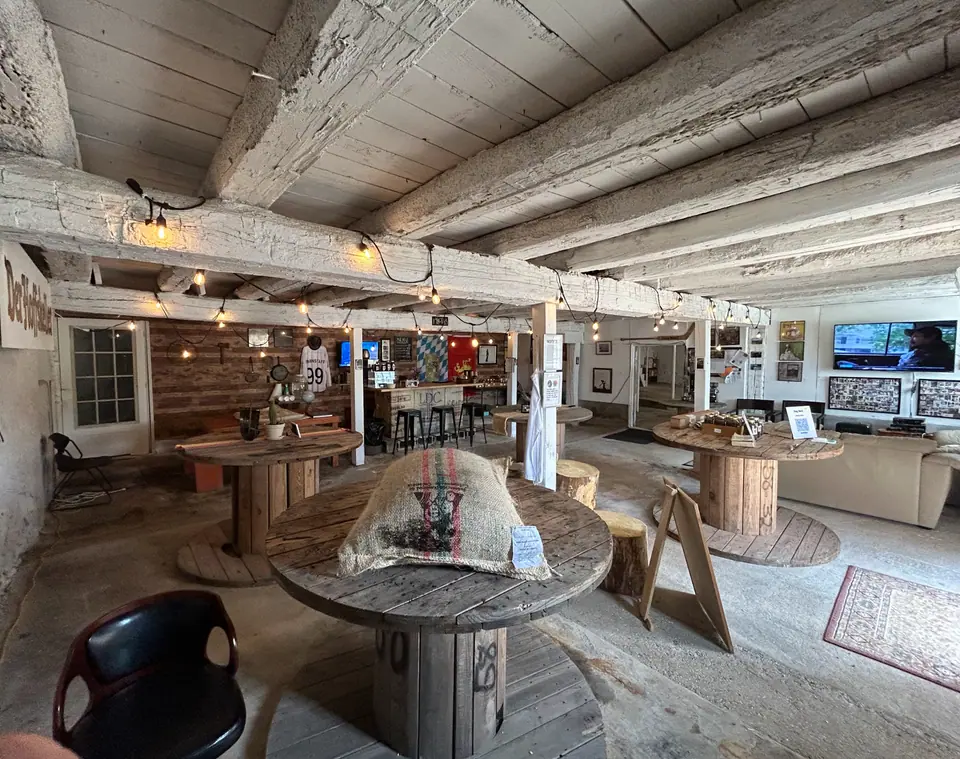
Farm cellars, or Hoffskellers, represent a rural counterpart to urban Ratskellers, blending storage with social functions on agricultural estates. The term Hoff (farm or court) evokes Old Norse hoff (hall or farmstead), suggesting ancient Nordic influences on Germanic architecture. In Europe, farm cellars stored produce and fermented goods, sometimes hosting gatherings.
In the US, “basement barns” (also called bank barns) originated from European designs, particularly English and Swiss-German styles from the 1660s, becoming popular in the 19th century. Built into hillsides, the lower level (basement) housed livestock, while the upper stored hay, leveraging natural insulation. In Pennsylvania and the Midwest, these supported dairying in grassland areas. Early American barns drew from colonial longhouses, integrating cellars for efficiency.
Repurposing barn basements mirrors broader trends: old farm cellars become storage, workshops, or living spaces. Modern projects transform them into “farmhouse basements” with cozy, rustic designs for entertainment or housing. For instance, 19th-century root cellars in farmhouses are restored for active use, tying back to Hofkeller traditions.
Der Hoffskeller aligns with ongoing projects like converting barn basements into event venues or residences, preserving agricultural heritage while adapting to modern needs. This connects to Ratskeller history, where cellars evolve from utilitarian to communal, emphasizing cultural continuity in Europe and the US.