Looking for Coffee That Tastes Like It Did in Germany?
Let’s start with a conversation we’ve had at the farmers market more times than we can count, because if you searched your way here, odds are good you’ve lived some version of it.
A guy walks up to the booth. Usually a little older, often a veteran. He takes a free sample, brings it up to his face, smells it before he even sips it. And then his expression does this thing — softens, goes a little far away — and he says, almost to himself, “Man. This tastes like the coffee I used to get when I was stationed in Germany.”
Then, nine times out of ten, he tells us he’s been chasing that taste for years. Decades, sometimes. He’s tried every bag at the grocery store, every fancy roaster, every brand somebody swore was “just like the real thing,” and none of it ever scratched the itch. And here he is at a folding table in Wisconsin, of all places, suddenly nineteen years old again, standing in a little café in Germany on a cold morning with a cup of coffee that finally, finally tastes the way he remembers.
If that’s you, here’s some good news and an explanation. The good news is you’re not crazy and you’re not misremembering. German coffee really is different from typical American coffee, in specific and identifiable ways. And once you understand what those differences actually are, you can stop buying random bags and hoping. Let’s get into it.
German Coffee Culture Is Older and Deeper Than Most Americans Realize

There’s a whole German social institution called Kaffee und Kuchen — literally “coffee and cake” — the tradition of sitting down in the afternoon for a cup of coffee and a slice of something sweet, usually with family or friends. It’s not a grab-and-go gas-station transaction. It’s a ritual. You sit. You linger. You talk. The coffee is the centerpiece, not an afterthought you slurp in the car.
And here’s a fun one that surprises people: a lot of the coffee technology you use every day was invented in Germany. The paper coffee filter — the thing in your drip machine right now — was invented in 1908 by a German housewife named Melitta Bentz, who was sick of getting bitter grounds in her cup and punched some holes in a brass pot lined with her son’s blotting paper. That invention is the direct ancestor of basically every drip coffee maker on the planet. Germans have been obsessing over a clean, smooth cup for well over a hundred years.
So when you remember German coffee tasting better, more refined, smoother — you’re remembering a coffee culture with a serious head start and seriously high standards.
So What Actually Makes German Coffee Taste Different?
Here’s the part that matters. When American servicemembers and travelers describe missing German coffee, they almost always reach for the same handful of words: smooth. Strong but not bitter. Rich. Full. Drinkable black. Let’s break down why German coffee earns those words.
It’s roasted for smoothness, not for shock value. German roasting tradition favors a medium-dark to dark roast that’s deep and full-bodied but — and this is the key — smooth. Not the burnt, acrid, ashtray-bitter dark roast that a lot of American chains crank out by scorching cheap beans. German-style roasting aims for a rounded, mellow richness. Big brands you’d have seen over there, like Dallmayr, Jacobs, Melitta, and Tchibo, built their whole reputations on a clean, mild, never-harsh cup. Some of them literally process their beans to strip out the harsh, bitter irritants. The German palate broadly does not want a punch in the face. It wants depth without the bite.
It’s lower in acidity. That sour, sharp, tangy edge a lot of American coffee has? German-style coffee tends to dial it way down. The cup sits rounder and softer on your tongue. This is a huge part of what people are subconsciously missing — they remember coffee that didn’t feel sharp or sour, that they could drink cup after cup of without their stomach complaining.
It’s full-bodied and satisfying. German coffee tends to have real presence in the mouth. It’s not thin or watery. There’s a weight and a richness to it that makes it feel substantial and comforting, exactly the kind of cup you’d want to sit with for an hour during Kaffee und Kuchen.
And it’s brewed and respected properly. Filter coffee — Filterkaffee — is the everyday German standard, brewed carefully, served fresh, treated with respect. It’s not sitting on a burner turning to tar for four hours like the coffee at an American diner.
Put it all together and you get the thing people remember: a strong, rich, smooth, low-acid, full-bodied cup with no sour twang and no burnt bitterness. Coffee you can drink black and enjoy black. That combination is genuinely hard to find on an American grocery shelf, which is exactly why so many people spend years searching for it.
Why You Couldn’t Find It at the Grocery Store

The other problem is that most mainstream American coffee is roasted for the American market — either bright and acidic third-wave stuff or aggressively burnt dark roast — neither of which is the smooth, rounded, German-style cup you’re after. You weren’t doing anything wrong in your search. The thing you were looking for mostly just wasn’t on the shelf.
Now Here’s Why We Care About This So Much
So, here’s our stake in all this. We’re Max and Jack, two brothers who run a small coffee roastery called Der Hoffskeller out of the cellar of a hundred-year-old barn in Cedarburg, Wisconsin. And we’re German and Norwegian by heritage — that’s not a marketing gimmick, that’s our family.
When we set out to make coffee, we weren’t trying to chase trends. We were trying to make the kind of coffee our heritage actually drinks. We make exactly one roast, and we call it the German-Norwegian Blend, and the name is a literal description of what it’s built to do.
Here’s the idea. Germans traditionally love a darker, bolder, fuller roast — robust, rich, stands up to cream and cake. Norwegians, who are also among the biggest coffee drinkers on the planet, traditionally lean the other way: lighter, cleaner, smoother, highlighting the bean. Our blend marries the two. It has the deep, dark, full body of a German roast and the smooth, clean, low-acid finish of the Norwegian style. The German strength without the German-import staleness. The smoothness without the wishy-washy weakness.
And the way we get there is the same way the old European roasters did it before there were giant computerized machines: we roast in cast iron, today in a cast iron drum, using slow, deep, even heat from the iron itself. No hot-air blasting. No scorching. Just patient, traditional roasting that develops a rich, full body and breaks down the harsh acids naturally, so the cup comes out bold but smooth. Dark chocolate, toasted nuts, a little warmth like a campfire — and zero sour bite.
We’re not going to oversell it. We can’t promise it’ll taste identical to that one specific café in that one specific town where you were stationed in 1987 — memory is a funny thing and nobody can bottle 1987. But we can tell you that the qualities you’re chasing — the smoothness, the strength without bitterness, the richness, the low acidity, the drink-it-black satisfaction — those are exactly the qualities we built this coffee around. And we can tell you what we see at the markets, which is grown men getting a little misty over a paper cup because for the first time in years, the coffee in their hand tastes like home used to.
We’ve had folks who lived in Germany for years tell us flat-out it’s the closest they’ve found in the States. We’ve had veterans tell us it took them straight back to their tours. One fellow told us it brought back “awesome memories of Deutschland.” That kind of thing is, honestly, the whole reason we do this.
How to Get the Most “German” Cup Out of It
If you want to recreate the experience as fully as possible, a few tips:
Brew it fresh and brew it filtered. Honor Melitta Bentz and use a proper drip or pour-over. A clean filter cup is the German everyday standard for a reason. A French press or stovetop method works beautifully too if you like more body.
Drink it black first, before you reach for anything. The whole point of a smooth, low-acid German-style coffee is that it doesn’t need to be hidden under cream and sugar. Try it the way they’d serve it over there and you might be surprised.
And do the full thing at least once: brew a pot, cut a slice of cake, sit down, and don’t rush. That’s Kaffee und Kuchen, and it’s honestly a better way to live. The coffee tastes better when you actually sit with it.
The Bottom Line
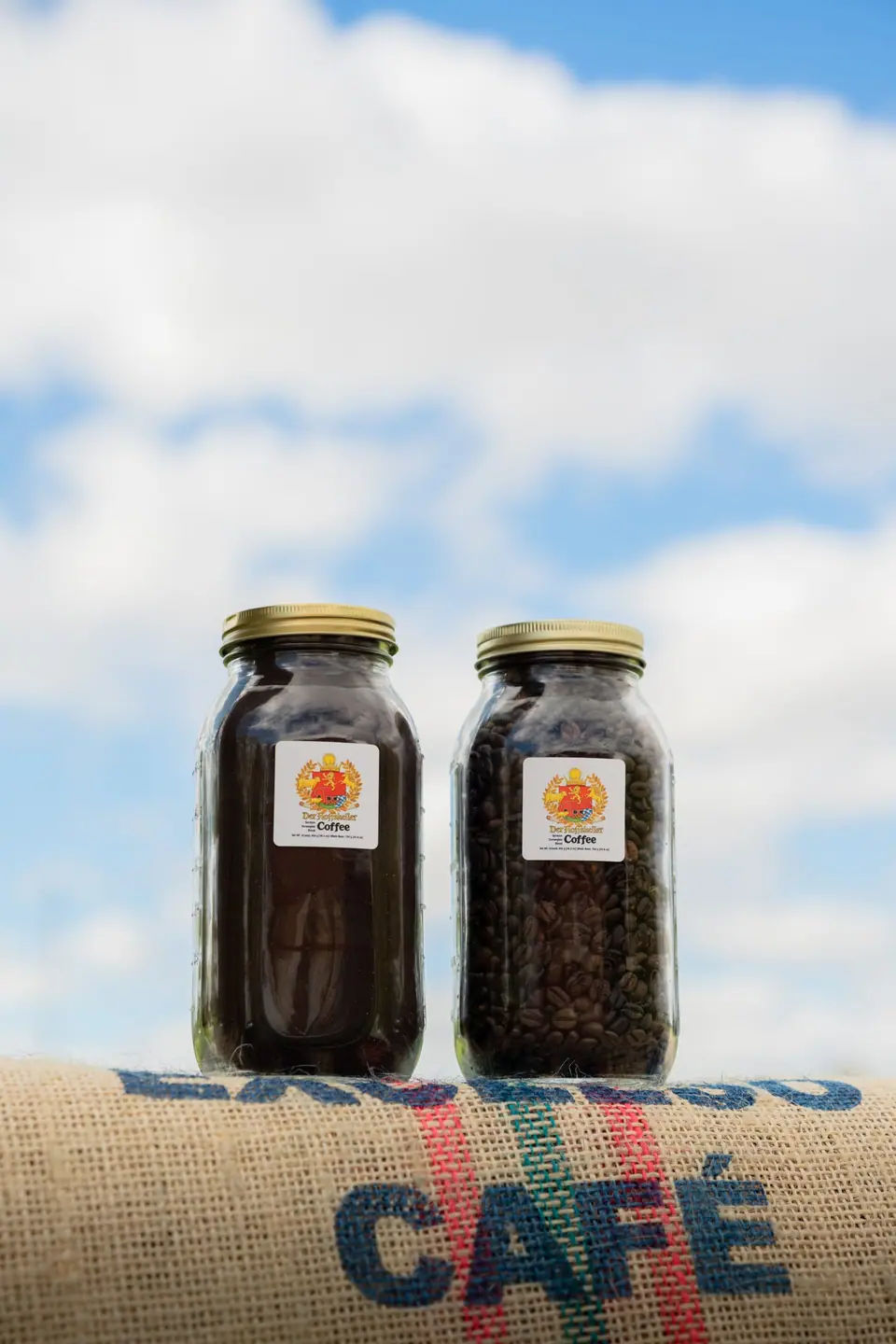
What you want is a coffee roasted in the old European tradition, fresh, for smoothness and depth instead of for shock value. That’s exactly what we set out to make with our German-Norwegian Blend — cast-iron roasted in small batches, packed in a Mason jar or a bag, and shipped free to your door anywhere in the United States on orders of $50 or more.
If any of this rang a bell — if you’ve been quietly missing a cup of coffee for years — do yourself a favor and try a jar. Brew it black on a cold morning and see where it takes you. Worst case, it’s a great cup of coffee. Best case, you’re back in that little café, just for a minute.
Willkommen zurück. Welcome back. We’ll keep a pot on for you.