

What Does Colombian Coffee Taste Like? Strength, Acidity and Roast, Answered
Colombian coffee usually tastes balanced and clean: medium-bodied, gently sweet, with a bright but not sharp acidity. Roasted light, it leans toward citrus and fruit. Roasted medium to medium-dark, it turns nutty and caramel-sweet with a rounder body. "Colombian" names where the coffee grew, not how it was roasted, so the roast level on the bag tells you as much as the country does.
We are a family roaster in a barn in Cedarburg, Wisconsin, and the only bean we roast is Colombian. Here is why Colombian coffee tastes the way it does, what roast does to it, and the questions people ask before they buy.
An origin, not a roast
The word Colombian on a bag tells you where the beans grew, not how dark they were roasted. French roast is the opposite: it names a roast level, not a place. The National Coffee Association lists French and Italian among the dark roasts, with shiny, oily beans and a pronounced bitterness.
So "Colombian vs French roast" compares two different things. A French roast can be made from Colombian beans, and a Colombian coffee can be roasted light, medium or dark. The grade on many bags works the same way: Supremo is Colombia's grade for the largest beans by screen size, and it describes size, not flavor. See our guide to Colombian Supremo.
Why Colombian tastes the way it does
Four things give Colombian coffee its familiar, balanced character.
- Arabica. Colombia's crop is almost entirely arabica, and 1Zpresso's Colombia guide notes that robusta there is still in the research stage. Arabica tastes smoother than robusta. More in arabica vs. robusta.
- Washed processing. NorthStar's origin guide calls Colombia the world's largest producer of washed arabica. In a washed coffee, the fruit is pulped off and the beans are fermented and rinsed before they dry. That makes a clean cup, where the bean's own sweetness and acidity come through clearly.
- Altitude. Most Colombian coffee grows between about 1,200 and 2,300 meters, roughly 3,900 to 7,500 feet, in the Andes. The cool climate slows the ripening of the cherries, which is credited with deeper, more complex flavor.
- Two harvests. Most regions bring in a main harvest and a smaller second crop called the mitaca. Since regions harvest at different times, fresh Colombian coffee comes in for much of the year.
Regions differ, too. Some Colombian coffees are heavy in body with chocolate and nut, and others are clean and lively with citrus and a jammy sweetness. Then the roaster decides which side of the bean you taste.

How roast changes it
Roast is the biggest lever on how a Colombian coffee tastes. As the roast goes darker, the bean's own brightness and fruit step back and the roasted flavors step forward. Here is the same kind of washed Colombian at four roast levels.
| Roast | How a Colombian tastes | The beans | Names you may see |
|---|---|---|---|
| Light | Bright acidity, floral and fruity notes such as citrus, a lighter body | Light brown, matte | Cinnamon, blonde |
| Medium | Balanced acidity and sweetness, gentle caramel and milk chocolate | Medium brown, not oily | City, American, breakfast |
| Medium-dark | Fuller body, nutty and caramel, lower acidity, a gentle roasted note | Deeper brown, a light sheen is normal | Full City |
| Dark | Bold and full-bodied, cocoa and smoke; the roast flavor leads, with more bitterness | Very dark, shiny and oily | French, Italian |
The light, medium and dark rows follow 1Zpresso's guide and the National Coffee Association's roast guide, which also notes that the lighter the roast, the more acidic the brewed coffee. Our FAQ gives the reason: the natural acids in the bean, chiefly chlorogenic acids, "break down as the roast develops." That is why a light-roasted Colombian and a French-roast Colombian can taste like two different coffees. For more, see what medium-dark roast is and whether dark roast is less acidic.
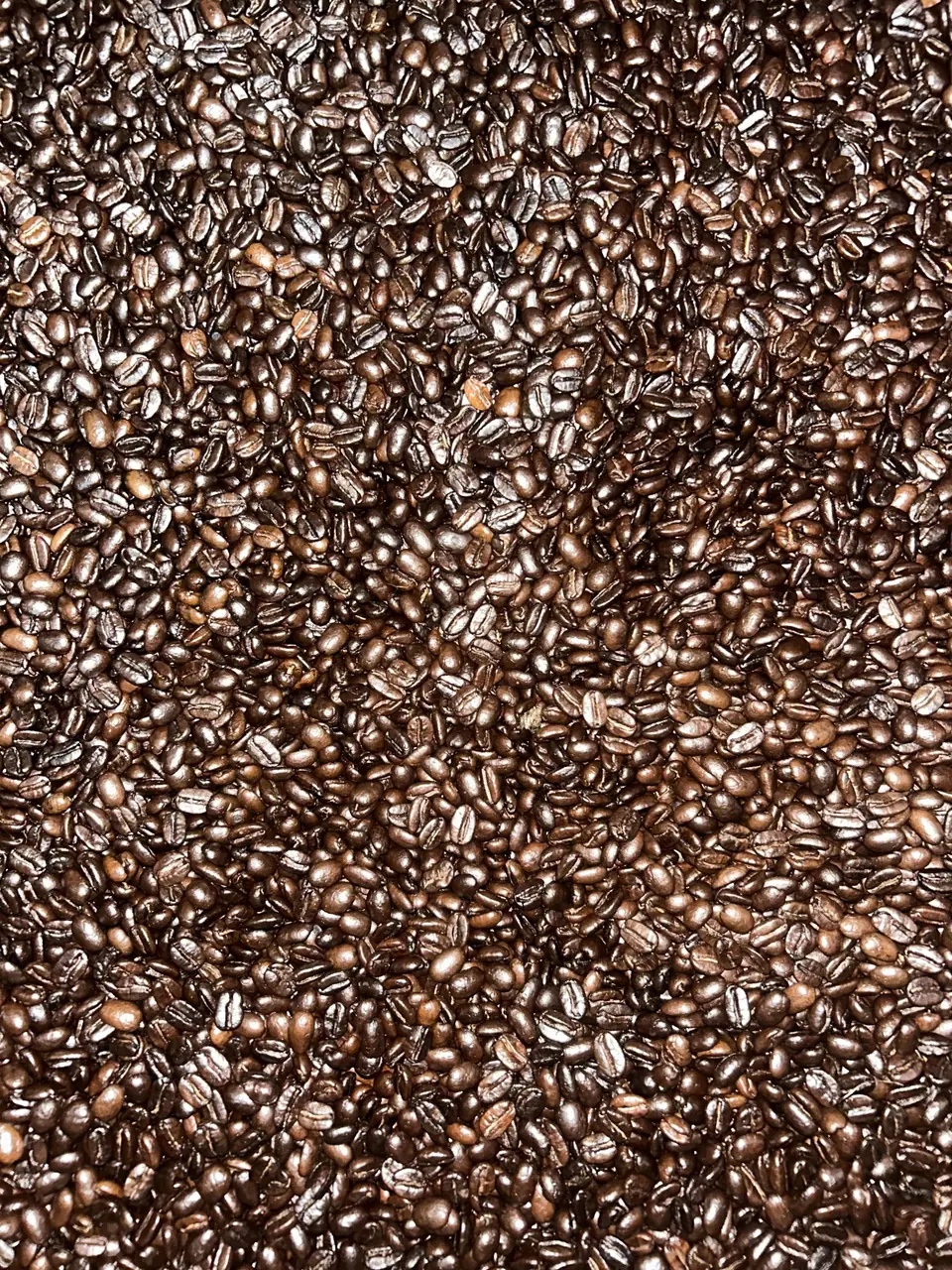
Is Colombian coffee strong?
"Strong" means two things, and neither one depends on the country. Strength of flavor comes mostly from how much coffee you use. Our FAQ puts it simply: "Most weak coffee is under-dosed, not under-brewed." Start with two tablespoons of ground coffee per six ounces of water and adjust from there. A darker roast tastes stronger, but the National Coffee Association notes that its strong flavor is not tied to caffeine.
Caffeine depends mostly on the species and the dose. Colombian coffee is arabica, which carries less caffeine than robusta, and roast barely moves the number. For a general range, the FDA lists 113 to 247 milligrams for 12 fluid ounces of regular brewed coffee. Ours is a normal arabica coffee that we have not lab-tested, so we do not give a figure of our own. More in how much caffeine is in a cup of coffee.
Tasting notes, plainly
Words on a bag like "caramel, citrus, milk chocolate" describe flavors the coffee resembles. Nothing is added. Many come from the Coffee Taster's Flavor Wheel, which the Specialty Coffee Association of America updated in 2016 with World Coffee Research. It sorts flavors into broad families such as fruity, floral, sweet, nutty and cocoa, and roasted.
You can read the notes on any bag as a quick guide to the roast:
- Fruity, floral, citrus or berry: usually a light roast and a bright, tangy cup.
- Caramel, nutty or milk chocolate: usually medium to medium-dark, rounder and sweeter.
- Dark chocolate, smoky or roasty: usually dark, with the roast in front.
We do not describe our own coffee with a list of notes. As our FAQ says, it "tastes like coffee rather than like a flavor profile."
How ours tastes
We roast one coffee: 100% Colombian Supremo Arabica, medium-dark, German Norwegian style. We began in a cast iron pan, then built custom cast iron stovetop roasters, and now use a cast iron drum roaster. The roast releases beans at different points, so each batch holds a spread of roast levels: by the time the first beans reach the second crack, others are still a few shades lighter. Customers describe the result as smooth, bold and low in acid, and good black. In their words:
“Where our usual has more fruity notes, this has more of a nutty base.”
TexasLolli64, X, September 2026
“It is not bitter. It has a really nice after taste that I enjoy, but it is a little different. It's not "smokey" or "woody" tasting, it's not chocolate like. Just good, hardy coffee flavor!”
Dave R, Google, February 2026
“The coffee is a nice mix of smooth and bold.”
Bret C, Google, August 2025
Read more about our German Norwegian blend, what makes our coffee different and coffee you can drink black.

When another Colombian suits you better
If the Colombian you love is bright and fruity, with citrus or red fruit up front, look for a light roast from a specialty roaster, often from a single farm with tasting notes on the label. As our FAQ says, "We roast medium-dark for a smooth, traditional cup. Different goal, different result." We also make no decaf, no flavored coffee, no pods and no light roast, and we ship to US addresses only.
If you want a nutty, rounded Colombian you can drink black, that is the cup we make. Ground is one medium-fine grind that works for every brew method, espresso included, and The Hoff, ground (1 lb, $25) is a fair first bag. If you grind at home, the Big Hoff Bag, whole bean (2 lb, $34) suits a pot every morning. At about 35 eight-ounce cups per pound (our estimate, at the standard strength of the SCA golden cup), the 2 lb bag makes about 70 cups, roughly $0.49 a cup. We ship by USPS, and shipping is free on orders of $50 or more.
Colombian coffee questions
Is Colombian coffee bitter?
Not by nature. Washed Colombian arabica is usually described as clean and balanced. Bitterness mostly comes from a very dark roast, water left too long on the grounds, or coffee left cooking on a hot plate. Customers describe our medium-dark as smooth and not bitter. If your cups taste harsh, our guide to why coffee tastes bitter walks through the fixes.
Is Colombian coffee acidic?
Lightly roasted, it has a bright, lively acidity. As the roast goes darker, the natural acids break down and the cup tastes softer. Customers describe our medium-dark as smooth and low in acid.
Is Colombian coffee good for espresso?
Yes, especially at a medium to dark roast, where it gives a rounded shot with cocoa and caramel. Our roast pulls well as espresso, and our ground coffee works for espresso as it comes. If you grind right before pulling the shot, order whole bean.
What is the difference between Colombian and French roast?
Colombian is an origin and French roast is a dark roast level, so a Colombian coffee is a dark roast only if the roaster made it one. French roast can be made from beans of any origin. It tastes smokier and more bitter, but it is not higher in caffeine. Ours is medium-dark.
Taste a Colombian from the barn
If you are near Cedarburg, the barn at 1040 Sherman Road is open every day from 9 to 5, with a free cup of coffee for visitors. Taste it black and decide for yourself. For more help choosing a coffee, browse our coffee guides.